|
The Liebman –
Loveman Family |
|
Click on a
name in either family tree below for more information on many
individuals listed. For a full page, printable family tree,
click
here for the top tree and
here for the bottom one.
New Jersey and
Cleveland Branches
|
|
|
Southern Loveman
Branch
|
|
| |
|
| |
Those Who Stayed Behind: Survivors - III
|
 nna
Liebman Pasternak (1896-1977) was one of 12 children – all
but one were daughters – of
Aron Liebman (?-1929) of Durkov.
Aron, a son of
Bernard Loveman (1800-1887) and
Esther Wirkman (?-1852), was a brother of
Adolf
Bernard Loveman (1844-1916), but unlike his brother,
he never left Hungary. Anna was a daughter by Aron’s second
wife,
Irma Weinberger (?-1944). She married Simon Pasternak (1895-1985) of Tallya, the scion of
a prominent, orthodox Jewish family that had operated
vineyards and a flour mill for seven generations in this town,
which was centrally located in the famous Tokaj winemaking
region. Their children were Clara (1922-), Hedwig, or Hedy (1921-2015) and Alfred (1930-2023). nna
Liebman Pasternak (1896-1977) was one of 12 children – all
but one were daughters – of
Aron Liebman (?-1929) of Durkov.
Aron, a son of
Bernard Loveman (1800-1887) and
Esther Wirkman (?-1852), was a brother of
Adolf
Bernard Loveman (1844-1916), but unlike his brother,
he never left Hungary. Anna was a daughter by Aron’s second
wife,
Irma Weinberger (?-1944). She married Simon Pasternak (1895-1985) of Tallya, the scion of
a prominent, orthodox Jewish family that had operated
vineyards and a flour mill for seven generations in this town,
which was centrally located in the famous Tokaj winemaking
region. Their children were Clara (1922-), Hedwig, or Hedy (1921-2015) and Alfred (1930-2023). |
|
Shortly after Alfred’s Bar Mitzvah in April 1944, the
Nazis entered Hungary. The Pasternaks and other Jews of Tallya
were forced into the ghetto in Satoraljaujhely, and after six
weeks, transferred from there by cattle car to Auschwitz. There
the men and women were separated.
Alfred and his father did not remain there long; shortly after
their arrival they were sent to the Dörnhau concentration camp
in Lower Silesia, where they remained until liberated
by the Russians on 9 May 1945. |
 |
|
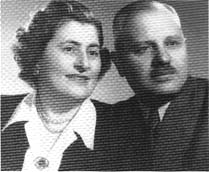
Anna and Simon
Pasternak, 1950 |
|
Alfred Pasternak
has written a moving account of the saga of the Pasternak family
and his own experiences at Auschwitz and Dörnhau during the war
that can be read
here. |
 |
After the war,
Alfred and his father returned home in an arduous, two- week
journey. They were reunited with the women in their family, who
had also miraculously survived the war. Simon rebuilt his
business and Alfred returned to school, eventually entering
medical school, specializing in obstetrics and gynecology.
|
|
Tallya, Hungary. Click to
enlarge. |
|
When the Soviets
crushed Hungary's 1956 Revolution, Alfred, Clara and her family left Hungary.
They escaped on December 8, 1956, taken by truck to the Austrian
border, after which they walked for four hours until, guided by
a smuggler, they came upon an Austrian village. Their parents
followed in similar fashion a few weeks later. The U.S. Embassy
in Vienna took them to Hamburg, from which they sailed to New
York. After two weeks' detention at Camp Kilmer in Edison, New
Jersey, they received green cards and traveled to Los Angeles
with the assistance of the Hebrew Immigrant Aid Society (HIAS)
to join Hedy, who had
emigrated to the U.S. in 1948 and settled there. Alfred went on to postgraduate medical training at
Cedars-Sinai Medical Center in Los Angeles, where he remains on
the faculty. He also holds a clinical professorship at UCLA
Medical School and has received many honors and accolades. |
 |
Alfred
went on to become a world expert on medical issues and
the Holocaust. He has lectured and published extensively
on Nazi concentration camp medical experiments and the
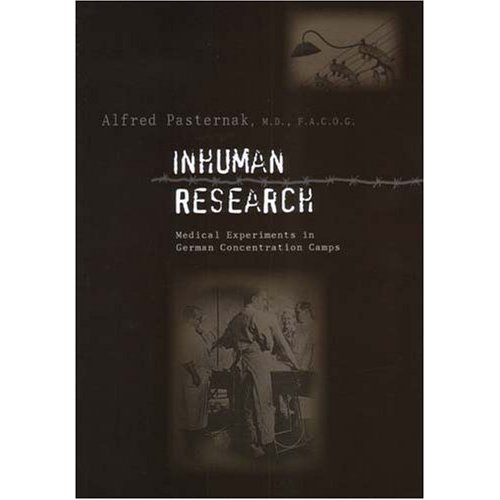
doctors who conducted them and in 2006 published what
the Hungarian Academy of Sciences called a "definitive
monograph" on the subject entitled Inhuman Research.
|
 |
|
Inhuman
Research, 2006. Click to enlarge. |
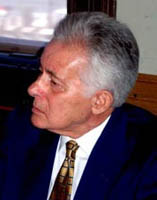
Dr. Alfred
Pasternak |
|
The book
is at once a memorial to 96 of his loved ones who died
in the Holocaust, a rebuttal to the disinformation put
forth by Holocaust revisionists and an ethical warning
to physicians. |
|
|
|
 |
Click on any underlined words in the site for more information. For
acknowledgments and contact information, click
here. |
|
|
|
|
©
Scott D. Seligman, 2007-2019.
All rights reserved. |
|
|